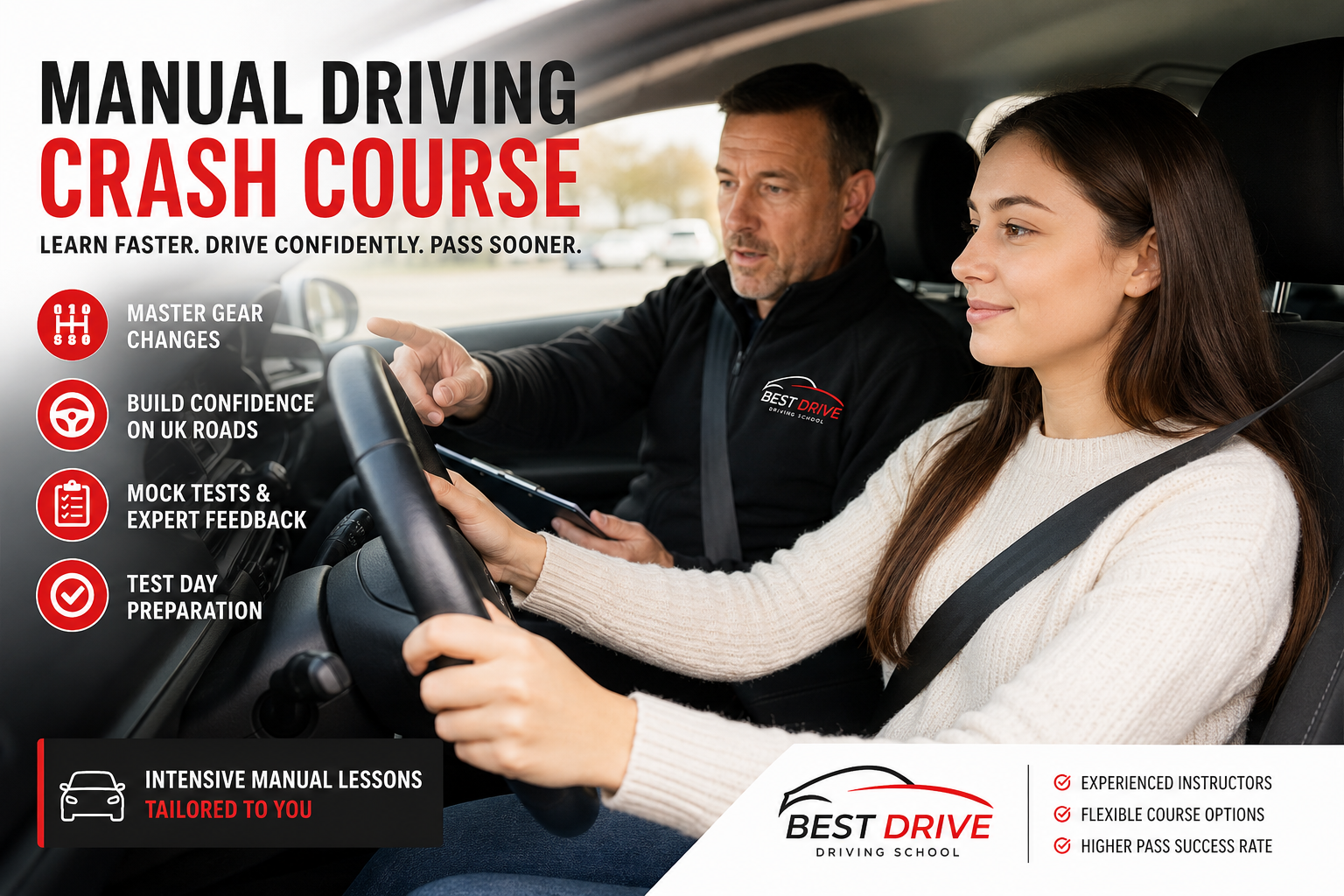
At first, it is difficult to learn how to drive a manual transmission. A lot to learn, a lot to remember — clutch control, changing gears, starting on the hill. Nevertheless, a lot of students opt for manual lessons owing to their flexibility after passing. The manual driving crash course is a way to get things done quicker without rushing through it. You don’t have to spread lessons out over a lot of months; you learn in focused lessons in a shorter amount of time. This is frequently beneficial in keeping students focused and in developing confidence more rapidly.
Intensive training is a type of manual driving training that can help you pass your driving test faster and get to become a competent driver on the UK’s roads.
What Is a Manual Driving Crash Course?
Manual driving crash course is an intensive training programme that will enable a learner to acquire driving skills in a shorter period of time. You’re taking a few days or weeks of driving several hours a day instead of taking a lesson a week or two.
The aim is simple. You get comfortable and keep your mind fresh while driving safely.
The majority of crash course manual driving programmes contain:
- Practical driving lessons
- Manoeuvre practice
- Dual carriageway driving
- Mock driving tests
- Test-day preparation
- Assist with changing gears and holding them in place
There is also a practical test at the conclusion of some courses. That can help the entire process be much less stressful.
The amount of confidence you have plays a big role. Most beginner students will require longer courses, and students who have had some experience may prefer to take shorter intensive courses.
Who Should Take a Crash Course Manual Driving Programme?
Intensive driving courses are not only for complete beginners. In fact, they suit several types of learners.
Students with a high need to pass quickly.
There are times when people require a licence to work, to go to University, or to look after their family. Lessons may be too long to be given on a weekly basis. A crash course driving manual assists students in moving forward more quickly.
Nervous Drivers
Learners generally do not cope well with extended periods of free time between lessons. The momentum continues with intensive lessons. This can make it easier for nervous drivers to get the hang of driving.
Students who have been unsuccessful in the past.
When you fail a test, it can throw your confidence into turmoil. Manual lessons that can be focused on working directly on weak areas before repeating.
Drivers are required to return after a break. Drivers have to come back after a break.
Work and finances have led to students dropping out of lessons for many months. A Manual Driving Crash Course is an excellent alternative to learning to drive from the ground up and is a good method for refreshing driving skills quickly.
Benefits of Intensive Manual Driving Lessons
Intensive driving courses in the UK are still popular and for a good reason.
- Faster Learning Progress
- Frequent driving aids better memory. You don’t have to repeat old errors.
- Repeat practice makes good driving habits.
Better Clutch Control
For manual cars, there is a need for coordination of the clutch, gears and acceleration. Driving daily will help build muscle memory quicker than driving weekly.
Improved Road Confidence
The more times you do it, the more confident you will become. After a few intensive sessions, learners will often see a significant improvement.
Flexible Course Options
Many driving schools provide:
- 10-hour courses
- 20-hour courses
- 30-hour courses
- Semi-intensive options
- Beginner to test packages
It gives students a choice of courses that are appropriate to their level.
Potential Cost Savings
Although crash courses might be costly at first, they can cut down on the total amount of lessons required. In fact, some learners spend less than for long-term weekly lessons.
How Long Does a Manual Driving Crash Course Take?
There isn’t one fixed answer. The duration of the course will vary according to experience, confidence and learning speed of the student.
Here’s an approximation:
- Experience Level Suggested Course Length (in hours):
Beginner 30–40 Hours - Some Experience 20–25 Hours
- Nearly Test Ready 10-15 Hours
Some pupils finish within 1 week. Some extended it over two or three weeks to give it a steady pace.
I’m being truthful, some people learn too fast. A good teacher will always push students to take an achievable course and not one they cannot handle.
What Happens During the Course?
Every instructor teaches differently, although most manual-intensive courses follow a similar structure.
Day One: Basic Car Control
The typical opening for you will be:
- Cockpit checks
- Moving off safely
- Clutch control
- Gear changes
- Stopping smoothly
This section is a bit awkward for people who are new to the game. That’s perfectly normal.
Building Road Skills
When basic control is achieved, lessons progress to:
- Junctions
- Roundabouts
- Traffic handling
- Lane discipline
- Mirrors and observations
- Manoeuvres and Parking
You’ll practise:
- Parallel parking
- Bay parking
- Pulling up on the right leg
- Reverse manoeuvres
- Mock Driving Tests
Mock tests aid the learners in preparation. They also point out areas for improvement before test day.
Practical Driving Test
For many intensive courses, the practical test is a component of the end-of-course assessment. At this point, you can expect students to be far more prepared than they thought.
Manual vs Automatic Intensive Courses
It is up to the individual to decide which lessons they want to take, manual or automatic.
Why Choose Manual?
A manual licence will enable you to drive manual and automatic vehicles. This will leave you with more options later.
Also, the manual cars are frequently:
- Cheaper to buy
- Cheaper to insure
- More widely available
- Why Some Learners Prefer Automatic
Automatic cars take away the pressure of clutch control and gear changing. They are easier for some learners when there’s lots of traffic.
However, there are still many individuals who would like to learn the manual way first. Afterwards, almost any car seems easier to drive after you have mastered this skill.
- Here are some suggestions on how to speed up your manual car.
- Passing quickly is more than just lesson hours! Your attitude is important, too.
Practise Between Lessons
A huge difference can be made with having a qualified supervising driver in private practice.
Skills can be reinforced on even short trips.
Focus on Observation
Learners often make errors related to mirrors or not making observations when they approach junctions because of the driving test.
Perfect steering is not as important as good observation habits.
Be careful when changing gears.
Students tend to panic and switch gears too early when they are new learners. Slow is smooth and smooth is fast.
Why Choose Best Drive?
Best Drive teaches a Manual Driving Crash Course, based on real drivers and real roads in the UK.
The instructors realise that each student learns uniquely. Some require additional confidence-building assistance. Some require additional assistance in building confidence. For others, it’s just about setting up for the structured preparation prior to the driving test.
Educators at Best Drive provide each learner with flexible lesson plans, patient teaching and focused tuition that results in lifelong driving skills.
The calm approach to teaching is appreciated by many learners. That’s more important than they realise. Ease of driving can make all the difference in the learning journey.
For a manual driving programme that isn’t too rushed and looks after you, Best Drive might be an option.
Conclusion
It may be better to take a few weeks’ worth of lessons in a single manual driving crash course than to take a few lessons weekly. The targeted structure helps maintain the skills and build confidence in the driving position.
All students learn at different rates, of course. Others go away very soon. Some take longer, and that’s okay. What’s important is developing safe driving habits that you will keep with you for the rest of your life.
When you’re looking to learn seriously and want the support structure to help you along the way, then Best Drive is the place to begin with a feeling of confidence!
FAQs
Q: How long will a manual training session for driving take?
Ans: Beginners require approximately 30-40 hours. Learners who have had some experience may require fewer lessons.
Q: Is driving a manual car a difficult course?
Ans: Sometimes it’s hard at times, particularly the first few days. However, with regular practice, students’ progress is rapid.
Q: Can I pass my driving test in 1 week?
Ans: Some students do pass within a week. Typically, this will rely on the driving history and confidence of the individual.
Q: Is it better to have a lesson each week or a course that has a lot of manual work?
Ans: Yes, for many learners. Intensive lessons allow for consistency and minimise longer learning gaps.
Q: Are crash courses a part of the driving test?
Ans: There are many driving schools that offer the practical test as part of their package. Please check before booking.
Q: Is manual driving more difficult than automatic?
Ans: Manual driving takes more coordination due to clutch and gear control. Yet, many pupils make progress more quickly than anticipated.
Q: Is it possible to have intensive courses for nervous learners?
Ans: Yes. In fact, some nervous learners would rather have intensive lessons as this is a gradual confidence-boosting process, and regular driving is preferable.
Q: What do you expect from the first lesson?
Ans: Take a provisional licence and wear suitable, comfortable footwear for driving.
You can also explore helpful driving guides and learner tips published on platforms like Blogspot, WordPress, Medium, and Weebly, where many instructors and driving schools, such as Driving Lessons, share useful advice for new drivers.