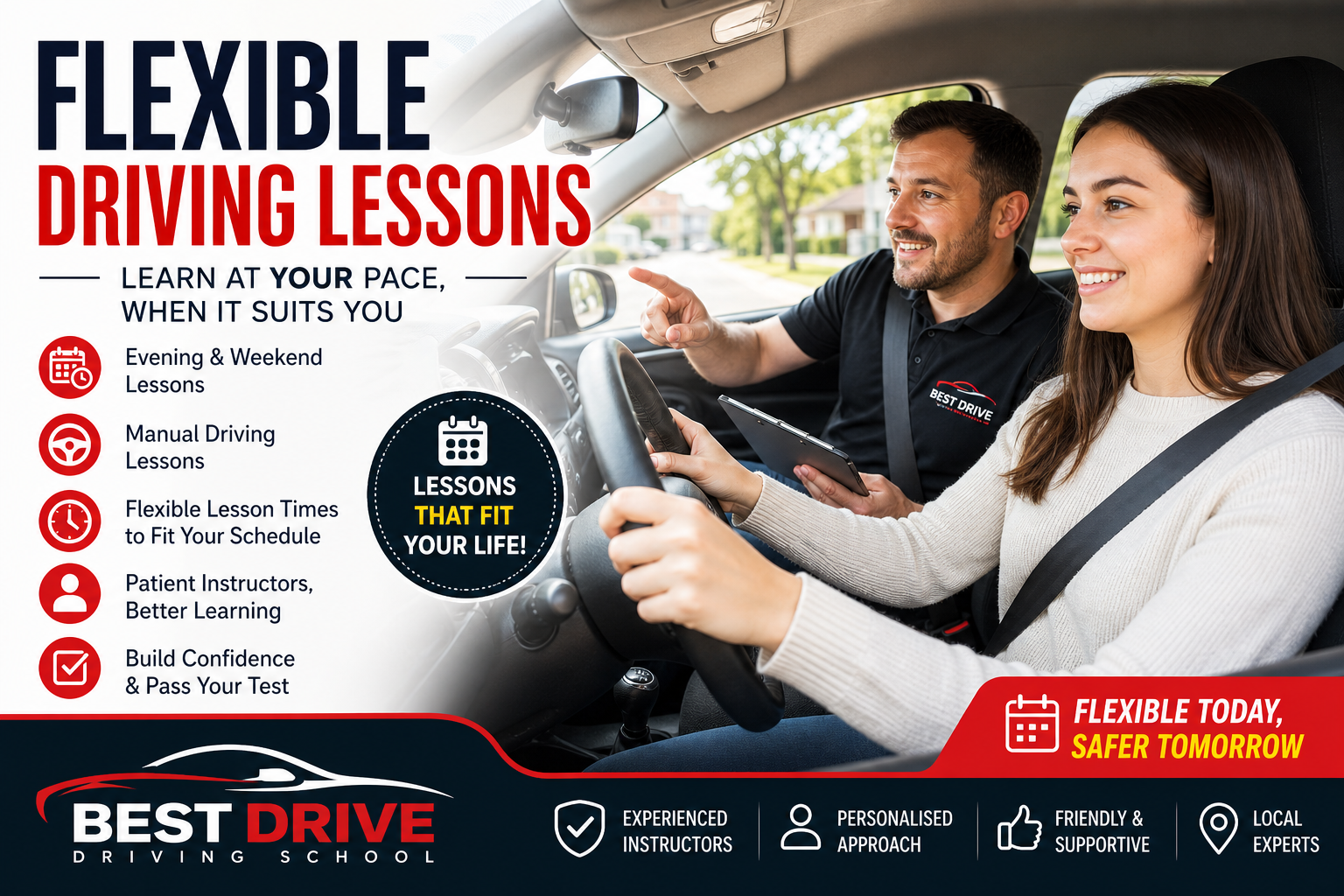
Driving is a fun learning experience. But occasionally it can be difficult to attend lessons. These days, driving lessons are more likely to be a part of work, university and family life and a full life! That’s why flexible driving lessons are a popular option in the UK.
Today’s students do not want their lives planned for them every week to attend lessons. These others prefer to take lessons in the evening. Others have to take weekend courses or intensive driving to be able to pass quickly.
At Best Drive, lessons can be arranged at times which suit the learner and can be tailored to increase their confidence with appropriate teacher support.
But for all drivers, both novice and expert, flexible learning can help reduce the stress of driving.
What Are Flexible Driving Lessons?
Flexible driving lessons are lessons which are organised to suit the lifestyle of the learner. Pupils can choose the time of the lessons which are suitable to them and their availability, not fixed.
This approach offers the learner more opportunities to assume control of:
- Lesson times
- Weekly schedules
- Learning pace
- Instructor availability
- Course intensity
Some pupils want to have one lesson a week. Some choose to repeat the lessons a few times to build up steam prior to their driving test.
Flexible driving lessons may comprise:
- Evening lessons
- Weekend driving lessons
- Intensive driving courses
- Refresher lessons
- Motorway lessons
- Beginner sessions
This has been a successful way of learning for pupils, parents and full-time employees who are unable to attend a lesson daily for a week.
The greatest benefit of flexibility is that it decreases the pressure on the learner. Lessons are integrated into daily life, which makes driving easier.
Benefits of Flexible Driving Lessons
All learners progress at their own pace. Flexible driving lessons enable individuals to study in a manner that is comfortable and manageable for them.
Learn at a student’s own rate
Some people are quick learners, and some take longer to acquire certain skills. Flexible lessons enable the teacher to cater for individual learners whilst not hurriedly moving through the lesson.
Easier Scheduling
It can be challenging to keep up with driving lessons due to a busy schedule. Flexible booking time helps learners to keep the momentum going and not be overwhelmed.
Reduced Stress
Learning is better if it can occur in a relaxed setting. If you schedule lessons at times that are convenient for you, the stress of lesson time may be reduced and attention focused during lessons.
Better Lesson Consistency
The learner will be more likely to attend regularly to lessons if they can plan lessons around work or university. Ongoing work will result in quicker improvement.
Confidence Building
Pupils develop confidence as a result of repetition and success. Lessons which are flexible do not lead to burnout or frustration.
Incorporate more choices into learning. Increase the choice of learning.
Learners find it attractive to be able to adjust the frequency of lessons to suit their level of confidence and/or future test date.
Why Many Learners Choose Manual Driving Lessons
Manual lessons are still popular with some learners despite the rise in the number of automatic cars.
Increasingly, more students are learning about the many things that go into driving an auto, but many still opt to take manual driving lessons.
In the future, they will have more control and flexibility when driving a stick shift.
Wider License Benefits
The passing of a manual car allows passenger cars to be able to legally drive automatic cars.
Better Vehicle Control
During manual driving lessons, pupils will be taught:
- Clutch control
- Gear changes
- Hill starts
- Speed management
- Better road awareness
These skills can have an impact on drivers’ sense of the car. These skills have the potential to increase driver-vehicle attunement.
Greater Car Choice
Cars that don’t have an automatic transmission are manual. Manual Autos are the vehicles that are not automated or even, sometimes, cheaper to buy or even to insure.
Stronger Driving Confidence
Pupils feel more confident after they have acquired more skills in manual driving lessons, which results in more confidence.
While this might seem daunting at first, for many drivers it’s worth it in the end.
Flexible Lesson Options Available
All learners are different and plan their own learning on an individual timetable. This is the reason why there are some possibilities to get driving classes in Regency. That is why there are flexible driving lessons with several training choices.
Evening Driving Lessons
Ideal for students who have daytime jobs or study at universities.
Weekend Lessons
On the weekend, there is support available for busy learners to ensure they make good progress but do not affect their work.
Intensive Driving Courses
Some students desire to pass quickly. Intensive courses are a way of having several lessons in the same course at the same time to accelerate learning.
Refresher Lessons
Drivers can slowly build up confidence as a driver after a long break.
Beginner Driving Lessons
Beginning learners can start to use the road safely without much hassle and can increase their experience as they go.
Motorway Lessons
It can be daunting for new drivers to drive on a motorway. A flexible motorway session is a safe environment for drivers to grow in confidence.
How Flexible Driving Lessons Help Nervous Drivers
It is very common to experience nerves prior to driving lessons.
Several learners are worried about the traffic. For some, the fear of making mistakes and halting the car during learning to drive lessons in a manual transmission can cause nervousness.
This can be substantially alleviated by flexible driving lessons.
Nervous learners can go slowly and steadily through training.
Patient teachers generally specialise in:
- Calm communication
- Positive encouragement
- Simple step-by-step learning
- Building confidence slowly
- Minimising fear of error
They help many nervous learners develop better if they can be made aware that lessons are designed to facilitate their learning, not to push them.
Confidence is developed with experience and practice.
There is no doubt that selecting the right driving school is crucial.
The selection of a driving school can have a tremendous impact on the driving school experience.
Learners need to take into account a number of factors before deciding to book lessons.
Qualified Instructors
The patient and experienced teacher can help the learner’s apprehensions from the beginning.
Flexible Availability
Those practice driving schools with evening and weekend hours are much more user-friendly for the working student.
Transparent Pricing
A clear pricing policy enables students to plan the cost of their education without unexpected charges.
Communication and Support
Errors will be recorded by the good teacher, and he will explain the errors well, and will be encouraging along the way.
Local Driving Knowledge
Local teachers know local test routes, local test junctions and problems for learners.
A driving school that focuses on building confidence as well as teaching the skills involved will probably provide a better learning experience.
Why Choose Best Drive?
Best Drive is all about providing learner drivers with confidence, safety and total support throughout their lessons.
Friendly Driving Instructors
Students are given peaceful and professional instructions in an enabling learning atmosphere.
Flexible Lesson Times
Driving lessons can be arranged at convenient hours and can be made to suit the students’ lesson times and schedules, enabling them to have driving time fit in with their lesson times.
Manual Driving Lessons are supported.
Best Drive is an incremental process of developing safe driving techniques.
Learner-Focused Teaching
Lessons are tailored to allow for each student’s skill level and experience.
Modern Teaching Methods
The methods of teaching are practical, manageable and clear, and lessons are engaging and productive.
Confidence-Based Learning
The focus on the comfort and confidence of the learner at the wheel is continued.
Tips for Getting the Most from Your Driving Lessons
To develop the skills to run their learning at a faster pace within flexible lessons:
- Spend time practising.
- Make enquiries in lessons
- Review mistakes calmly
- In cases where possible, apply the lessons outside the classroom.
- Do not be so preoccupied with winning; just get better.
- Getting adequate rest before lessons is important.
- Build confidence gradually
Gradual improvements throughout the lesson(s) result in good driving.
FAQs About Flexible Driving Lessons
But how can driving lessons be flexible?
Flexible driving lessons allow students to choose learning times to suit their normal activities and to select the most appropriate method of learning.
Would it be harder to learn to drive without a stick and a shifter?
Lessons will be harder the first few times the gear is set up, and it will be the responsibility of the students to operate the gears and clutch. However, there are many drivers who get used to driving in practice.
Do you have evening driving lessons available?
Yes. Several driving schools offer nighttime driving lessons for working or school-going people.
How many will be required for driving lessons?
Based on your confidence, experience and how often you practice it.
Are driving lessons with lots of lessons really effective?
Motivated learners who are okay with learning at a faster pace may find that intensive courses can help them to learn more quickly.
Do there exist any benefits of flexible lessons for anxious motorists?
Yes. Nervous students can learn flexibly at their own pace in a non-stressful manner.
How often do I need to take driving lessons per week?
The students value consistency in the form of 1-2 lessons a week.
Do driving lessons for flexibility help in preparing for driving tests?
Yes. Learners are well prepared, developing confidence through regular and planned lessons which are anticipatory of practical driving tests.
Conclusion
A person’s driving education should be an exciting, not stressful experience. Flexible driving lessons are an opportunity to help pupils learn at their own pace and make lessons fit into their very busy lives.
Flexible learning can help the process run smoother, and can make it possibly more enjoyable, whether you’re looking for evening lessons, weekend schedules or manual driving lessons.
Students can build up their confidence gradually with the help of the professionals of Best Drive and will be able to drive safely for years to come.
You can also explore helpful driving guides and learner tips published on platforms like Blogspot, WordPress, Medium, and Weebly, where many instructors and driving schools, such as Driving Lessons, share useful advice for new drivers.