
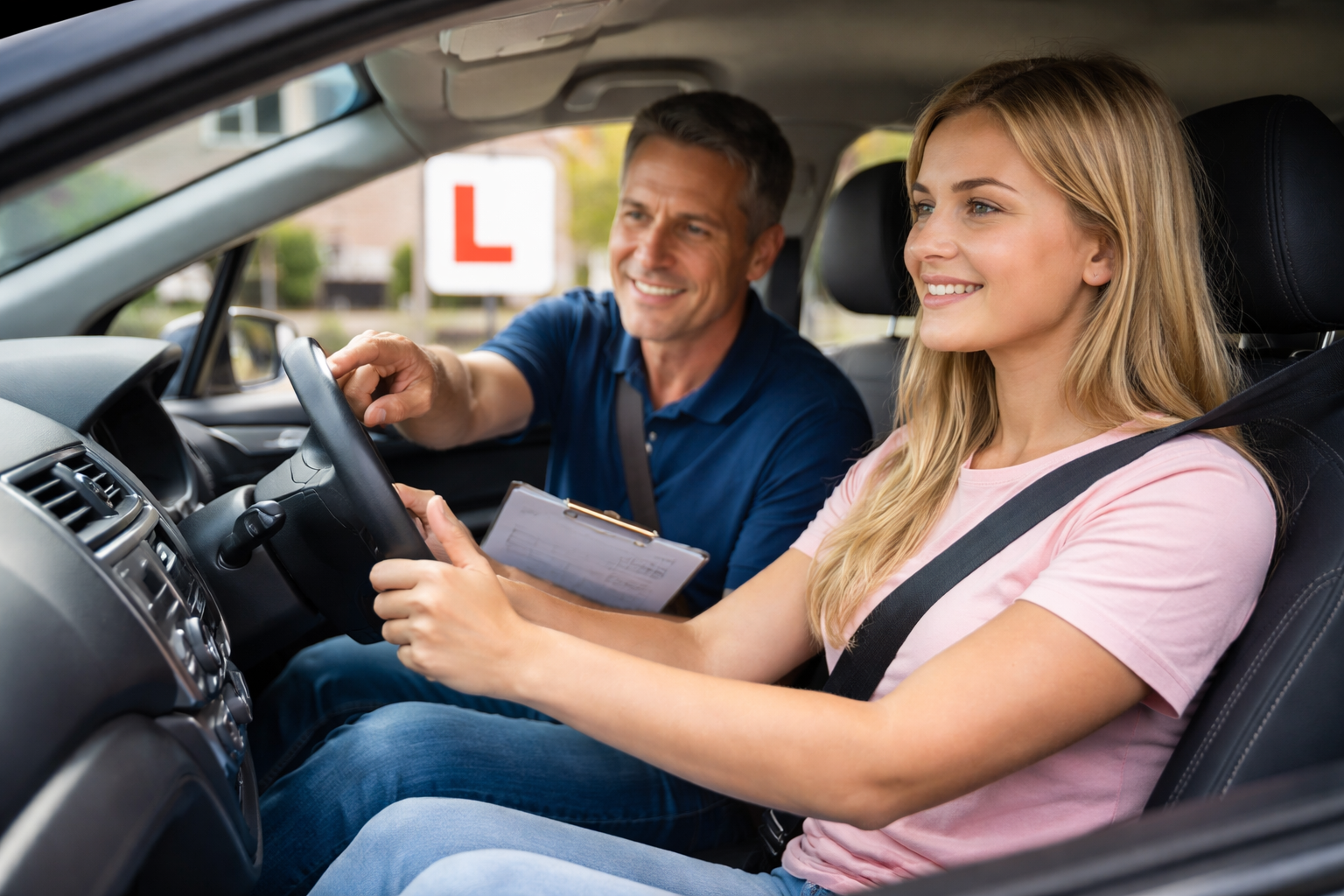
Your First Driving Lesson Tips: First driving lessons are a thrilling experience. It can be a tad stressful at first. It’s perfectly fine. Often, learners come into their first lesson unsure what to expect. This is something we see as instructors every day.
The good news is: The answer is simple. The first lesson will help you relax and build up to the basics in a step-by-step manner. Nobody expects perfection. There is no need to rush to build confidence, just the right amount.
These are First Driving Lesson Tips to understand what typically happens, and how you can prepare appropriately for your first time at the wheel.
What do you do on your first driving lesson?
This is a very common question in the minds of many learners at the start of their lesson. It’s a comfort. Your teacher will take you through all the details in a slow way.
Most of the time, the first lesson will contain:
Meeting your instructor
Your instructor will introduce himself and check your provisional license. This helps to establish trust from the get-go.
Eyesight check
May have to read a number plate from a close range. The following is a standard safety precaution.
Understanding car controls
Your instructor introduces the primary controls prior to driving anywhere. You will learn about:
- mirrors
- pedals
- gears
- steering wheel
- handbrake
This part will make you feel at ease inside the car.
Moving off practice
Then, it’s your turn. The majority of learners start on a calm road. Clutch control will be introduced to you gradually and carefully.
Basic steering practice
- You will learn to steer smoothly and, if necessary, with the instructor’s help.
- Short driving on quiet roads.Short driving on quiet roads.
- Most students are amazed at how fast the car moves. This always occurs in a safe area first, however.
At the end of lesson one, most learners are proud of their accomplishment.
First Driving Lesson Tips to Help You Feel Confident
The more you prepare, the more confident you will become. These are easy tips to help students relax before they get going.
Wear comfortable shoes
Shoes are thin and flat in order to better control pedals.
Submit a provisional license.
This should be checked by your instructor before starting.
Ask questions as necessary
During driving lessons, there are no silly questions.
Stay relaxed
Some initial nerves are normal. When the car moves, confidence quickly builds up.
Carefully read directions
- Your teacher will give you directions on each step.
- Take ownership of errors as learning opportunities
Many learners only get stuck once or twice. It is a perfectly normal occurrence.
What learners usually worry about (and why they should not)
There are a lot of concerns that new motorists have. Instructors see the same issues year after year when they are in the classroom.
Stalling the car
Nearly all learners pause in early lessons. It’s a learning of clutch control.
Traffic pressure
Your teacher will select quiet roads first. Busy areas are in last priority.
Doing something wrong
Errors will be allowed in lesson 1. Learning is done by doing.
Looking silly
All those who have driven before you began exactly where you are.
Once you start, you get more confident than you’re expecting to.
What instructors expect from you in lesson one
Sometimes the learner believes that he/she has to do a good job right away. That is not true.
Generally speaking, teachers expect three things:
- attention
- effort
- willingness to listen
- That is all.
It is not expected that you will change gears exactly as you should. Don’t worry, you don’t need to be a big-time driver. The pacing of learning is in the hands of your instructor.
How to prepare before your first lesson
There’s a lot that goes into it, and a little preparation makes a big difference.
Here are some simple things to do the night before your lesson:
- sleep early
- Bring your licence,
- wear comfortable clothes
- Try not to hurry to the lesson.
- stay positive
Having a plan in place often helps ease the worry of many students.
Common mistakes learners make in lesson one
It’s okay if things go wrong. Nevertheless, having some idea of what is typically covered in early lessons is helpful.
Some pupils hold the steering wheel too tightly. Others fail to do the mirror check initially. A lot of students are releasing the clutch too quickly.
- All of these are a part of learning.
- This is what your instructor expects and helps correct in a calm manner, step-by-step.
- Learning is more rapid if students are not concerned with their mistakes.
How long before you feel comfortable driving
All learners progress at different rates. After two lessons, some are feeling relaxed. Some take a bit longer.
In most cases, confidence is improved after the first couple of sessions, because:
- You know more about the controls.
- You’ll find your steering feels easier on the road.
- You can get better at controlling your clutch.
- Your awareness increases
Minor advances occur daily in the lessons. In no time, driving becomes second nature.
Instructor tip section
Here are some of the things teachers will normally say to students at the end of lesson 1:
- “Don’t wish for steering to happen, simply let it happen.
- Always “look up, don’t look down at the bonnet.
- “Relax your shoulders, it’s for control.
- These are the little changes that can greatly affect learning during the initial lessons.
Building confidence after your first lesson
Practice makes perfect. The second lesson can be easier because the vehicle controls are familiar.
- Most students report that after the First driving lesson tips, they have a bad reaction. That is because they now have an understanding of what they can expect.
- If the first lesson is difficult, remember one thing.
- All of the drivers you see today are, once more, just like you. All the drivers you see today were once like you.
- Keep practising. Keep asking questions. It will come as expected.
FAQs About First Driving Lessons
Are the first driving lessons challenging?
Most learners find the first lesson easier than expected. Your teacher takes his time to explain things slowly and clearly, making you feel at ease right from the beginning.
What do I need to take to my first driving lesson?
Take a provisional licence and wear comfortable shoes. It also helps to be relaxed and prepared to learn.
How long is the first driving lesson?
Most first lessons are 1-2 hours in length. This allows time to familiarise themselves with the controls and to practise basic movement.
Will I be able to drive straight away?
In many cases, yes. Once familiar with the controls, the learner typically drives the car on a calm road accompanied by someone.
May I make errors in the first lesson?
Yes, and this is perfectly normal. Errors enable teachers to learn how to assist their learning.
What do I need to do the night before my lesson?
Ensure you get ample rest and arrange your license ahead of time. Becoming calm and prepared will aid in learning.
You can also explore helpful driving guides and learner tips published on platforms like Blogspot, WordPress, Medium, and Weebly, where many instructors and driving schools, such as Driving Lessons, share useful advice for new drivers.