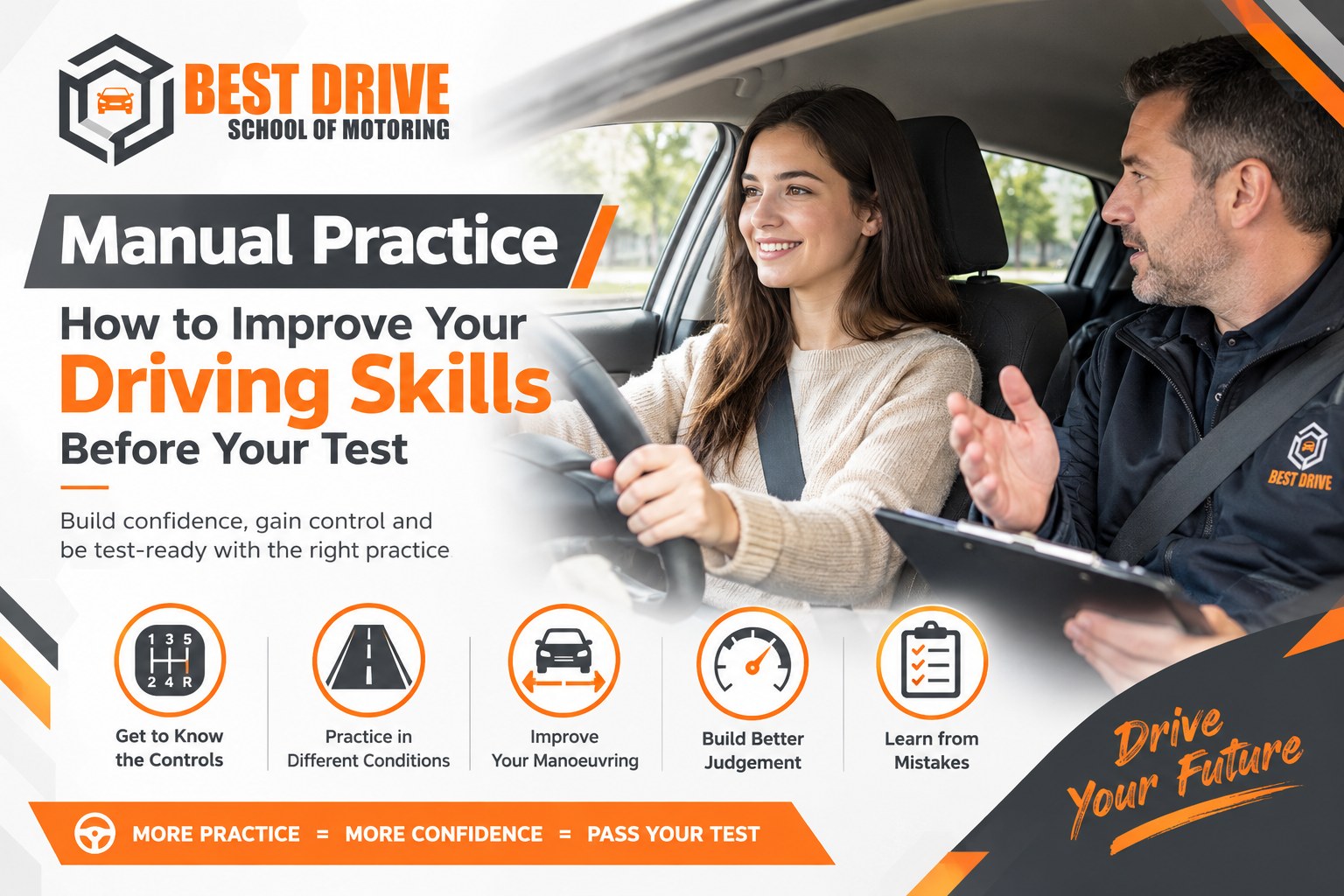
Driving lessons are a time-consuming process that requires patience and practice. When you are behind the wheel, manual practice will help you understand how the car works, control your speed, shift gears, and handle changing conditions. For those taking the driving test in the UK, practice makes perfect so that you feel more at ease on the road.
It is essential that drivers at BestDrive have a clear path and a consistent method to enhance their skills. Manual practice helps you develop driving habits to take control of your car, whether you are a beginner or preparing for your practical driving test.
What Is Manual Practice?
Manual driving is the practice of driving a car that has a manual gearbox. The clutch, gear stick, accelerator, and brakes are used to control the vehicle. A manual transmission car requires you to change gears based on speed, engine response, and road conditions, unlike an automatic transmission car.
These controls may seem challenging for novice drivers. You may stall the engine, shift gears too soon, or have difficulty getting the car started on hills. These problems tend to occur when learning.
With regular practice, you’ll develop an understanding of how each control operates. As time passes, gear changes are smoother, control of the clutch improves,ves and you are able to concentrate more on the road.
Why Is Manual Practice Important?
Through manual practice, you learn the skills required for safe and controlled driving. It also helps you get ready for the UK practical driving test.
Some of the main advantages are:
Better clutch control. How to locate the bite point and get out without stalling.
Smoother gear changes. The more you practice, the better you’ll be able to choose the correct gear for the speed and terrain you are driving on.
Improved hill starts. How to use the clutch, accelerator and brake when driving uphill.
Better road awareness. Once you have improved your vehicle control, you have more time to look for traffic signs, pedestrians, cyclists and other vehicles.
Greater confidence. By practicing commonly used driving maneuvers multiple times, you will become more comfortable during lessons and when driving on your own with a qualified supervisor.
Essential Manual Driving Skills to Practice
1. Clutch Control
Handling a clutch is a vital initial skill in a manual car. A clutch is a device that connects the engine to the gearbox. Smooth operation is used to move away without sudden movements.
Try on a calm flat road with proper supervision. Depress the clutch fully, put it in first gear, and gradually ease it in until you feel it bite. Gently increase the acceleration if necessary and ease off the clutch.
Don’t raise your foot too abruptly. The engine often stalls when the clutch is released suddenly.
2. Changing Gears
The right equipment will keep you in control and handle varying conditions. Moving away from a stop is often done in first gear. Higher gears are for higher speeds if road conditions are favorable.
Try to go through the gears slowly, practicing by hand. Always check speed and road position before changing gears. Don’t stare at the gear stick; look ahead at the road.
Your teacher will explain the up/down concept.
3. Hill Starts
Starting from a hill needs to be coordinated. If you let off the brake without obtaining sufficient grip, the car may roll back.
Train on a soft slope, in the company of a qualified trainer or appropriate supervising driver. Lock the car, determine the clutch bite position, and apply proper acceleration before taking off safely.
Don’t keep the car on a hill by pressing the clutch for an extended period. Use the appropriate brake technique for your vehicle and training level.
4. Moving Off and Stopping
All trips include ensuring safe take-off and stopping. Learn to scan the scene, identify the appropriate equipment and distance when the road is clear.
Prior to moving off, perform proper observation checks (mirrors, blind spots). Signal when necessary. Make sure your movement won’t put other road users at risk.
At a stop, glance in the mirror, and slow down gradually and carefully, then stop at an appropriate location.
5. Reversing Maneuvers
In the UK driving test, one of the skills tested relates to how well you can control a vehicle when performing reversing maneuvers. These involve parallel parking, parking in a bay, and pulling up on the right-hand side and reversing.
Slowly practice each maneuver in an appropriate area. Constantly scan for pedestrians, bikers, and vehicles. Steering control isn’t as important as accurate observation.
How to Build a Manual Practice Routine
A simple routine can get you to do one thing at a time. Need not do all maneuvers in all practice sessions.
Follow these steps.
Step 1: Define a goal. Pick a skill – clutch control, gear changes, or parking.
Step 2: Choose an appropriate site. Start in a quiet area, with good visibility and enough space.
Step 3: Repeat the exercise. Repeat the skill multiple times, keeping control and safety.
Step 4: Evaluate your progress. Recognize errors and talk about them with the teacher.
Step 5: Gradually increase the level of difficulty. Progress to harsher roads and more complex situations as your abilities get better.
A brief 30-minute session can be helpful to begin with. Depending on your experience, focus, and your teacher’s recommendations, the time can be extended or shortened.
Common Manual Driving Mistakes to Avoid
Typical errors are made by new drivers in manual practice. Being aware of these issues is the first step towards solving them.
Rushing to release the clutch. Slowly let the clutch out and become familiar with the “biting point.
Wearing improper clothing. Suit up according to road conditions and pace.
Examining the gear stick. Understand gear positions when not in motion, and continue to focus on the road when driving.
Braking too late. Anticipate and adjust speed in advance.
Forgetting mirror checks. Before changing speed or direction, look in your mirrors, if appropriate.
Panicking after stalling. Use brakes and lock the car, get back on the road safely, and scan for hazards before driving again.
How Manual Practice Helps You Prepare for the UK Driving Test
The UK practical driving test assesses your driving skills and your ability to manage safely and independently. Good observation, control of the vehicle, awareness of road signs,gns and appropriate response to traffic.
These demands can be prepared for with manual practice. Use junctions, roundabouts, meeting traffic, pedestrian crossings, parking, and driving independently with your instructor.
Have your teacher conduct a practice test. A mock test is a test that may pinpoint areas that require attention prior to your official test.
It is also important to go over your errors after every lesson. Emphasize the ‘why’ for each mistake made and repeat the skill. It is better to improve consistently rather than dash towards a test date.
Play without the legal or safety risks. Have the correct provisional license and carry L plates as necessary, and comply with UK supervision and insurance requirements. Structured training and feedback from a qualified driving instructor.
FAQs About Manual Practice
Q. What is meant by manual practice?
Manual practice involves learning and developing driving skills in a vehicle with a stick-and-shifter transmission. Clutch control, gear changing, braking, steering, parking, and safe road use are practiced.
Q. How many times per week should I manually practice?
Practice will be done during regular sessions. Follow your instructor’s cues and select an exercise that corresponds to your experience level. Concise, specific sessions can be useful for tackling individual areas of weakness.
Q. Does manual practice come easy to beginners?
It can be difficult to learn to drive a manual transmission first because there are multiple controls to keep track of. Most learners find that with practice and patience, they become more comfortable controlling the clutch and changing gears.
Q. What should I do if I am stuck while practicing manually?
Slowly increase the amount of clutch until it bites. Use appropriate acceleration and gently release the clutch. If the engine stalls, park the vehicle and try to start it up again safely.
Q. Should students do manual practice before a driving test?
Yes. Manual practice enhances vehicle control, observation, gear selection, maneuvers, and reactions to traffic. These skills will help you to drive safely while taking your test.
Q. Will I need to do manual driving with an instructor?
Professional lessons give guidance and feedback. There are also legal requirements for any private practice, such as appropriate supervision and insurance.
Q. How long does it take before manual practice produces results?
There is individual variation in progress. Your progress depends on your experience, how often you have lessons, your level of confidence, and your ability to correct your errors.
Q. Which manual driving skills should I learn first?
First, cockpit checks, moving off, stopping and clutch control, then gear changes. After mastering these skills with more control, practice junctions, roundabouts, reversing and parking.
Q. Does it make sense to practice manually after passing the driving test?
Yes. The more you practice, the better your habits will be, and the more you will get experience on different roads, traffic conditions, and trips.
Q. How do I know when I’m ready for my driving test?
Your instructor should evaluate your driving skills in various situations based on a range of maneuvers. Drive in a safe manner, make your own decisions, obey the rules of the road,oad and operate the vehicle without too many reminders.
Improve Your Driving Through Regular Manual Practice
Manual Practice guidance helps you master driving skills, understand traffic rules, and prepare for your driving test in the UK. Practice controlling the clutch, smooth gear changes, and safe observations and positioning. Repeat, review, and get feedback from your teacher.
BestDrive is a good resource for drivers looking for information on driving and vehicle skills. Stay on track, adhere to UK driving laws, and strive to become a safe, confident manual driver.